

How Pure Golf Flow Works
Pure Golf Flow is built for casual golfers and beginners who want simple score tracking and real improvement, without needing an official handicap. Behind the clean, “phone-stays-in-the-bag” experience is a lightweight system that turns your rounds into a clear, fair, and consistent improvement model.
Here’s the step-by-step process and the “science” that powers it.
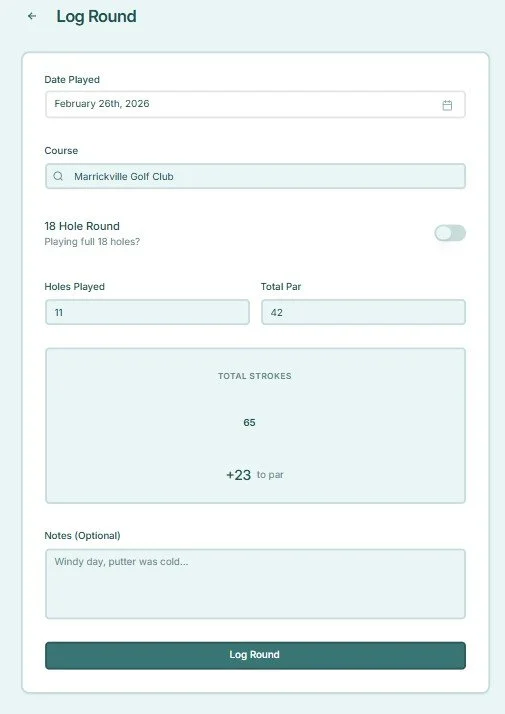
Step 1: You log the round (fast, minimal inputs)
Pure Golf Flow keeps data entry intentionally simple, so you can track golf scores without turning your round into admin.
You enter:
Date
Course
Holes played (4, 9, 13, 18—whatever you actually played)
Course par (for the holes you played)
Your score
That’s enough to create a reliable baseline for golf improvement tracking, even if you don’t play full 18-hole rounds every time.
Play Golf. Not Your Phone.
·
Play Golf. Not Your Phone. ·
Step 2: Everything is normalized (so different rounds compare fairly)
Casual golfers often play different formats, 9 holes after work, a random 12 on holidays, a full 18 once a month. Pure Golf Flow standardizes your data so you can compare apples to apples.
Behind the scenes, the app converts every round into a consistent measure:
Shots over par = (Your score − Course par)
Over-par per hole = (Shots over par ÷ Holes played)
This “per-hole” view is the key to tracking improvement with no handicap, because it works even when you:
play fewer than 18 holes
switch courses often
don’t have stable weekly play patterns
It’s simple math, but it’s powerful because it creates a fair baseline for beginners and casual golfers.
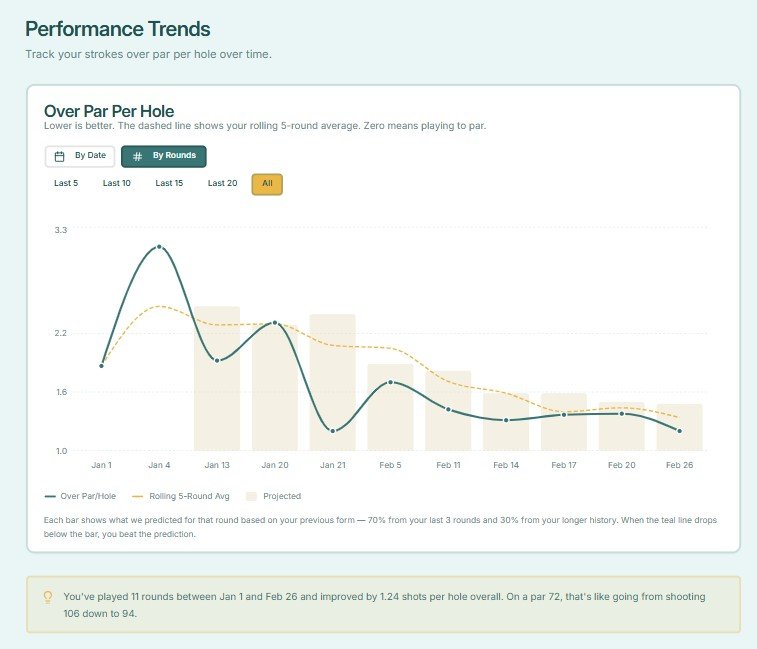
Step 3: A rolling performance baseline is created (your “Flow Baseline”)
Instead of building a traditional handicap system (complex, rule-heavy, and often intimidating), Pure Golf Flow builds a personal performance baseline using your own recent rounds.
This baseline is calculated from a rolling window of your rounds (example time filters you’ll show in screenshots):
Last 3 rounds (most recent form)
Last 5 / 10 rounds (more stable)
Last 30 / 90 days (trend view)
All-time (long-term story)
The app uses the selected time range to compute:
your average over-par per hole
your consistency (how much your scores vary)
your trend (are you improving over time?)
This gives you a clean, confidence-building answer to:
“How am I actually playing lately?”
Step 4: Your next-round “Expected Score” is predicted
Once you have a baseline, Pure Golf Flow can estimate your expected score for any course—without needing a handicap index.
Here’s the logic:
Take your baseline over-par per hole
Multiply by the number of holes you plan to play
Add that to the course par
So if you’re typically +0.6 per hole recently, Pure Golf Flow can project what that means on:
a quick 9-hole round
a full 18
a tougher course vs an easier one (because par changes)
This helps beginners and casual golfers set realistic goals:
“Break 100” or “Break 90” planning
“Can I beat my expected score today?”
“Did I outperform my trend?”
Step 6: You get improvement tracking that’s actually meaningful (not noisy)
Golf improvement isn’t always linear, especially for new golfers. Pure Golf Flow is designed to reduce the “noise” and highlight what matters:
Recent form vs long-term progress
Best stretch (your hot streaks)
Consistency (how repeatable your scores are)
Improvement over time (your trend line)
And because it’s normalized per hole, your progress still counts even if you only squeezed in 6 holes before sunset.
Step 7: Your data stays clean and usable (so your insights get better over time)
Every time you log a round, Pure Golf Flow:
stores the round data in a structured way (date, course, holes, par, score)
recalculates your baseline for each time window
updates trends and predictions automatically
So the more you use it, the more accurate your picture of real golf improvement becomes—without extra effort.
Why this works so well for no-handicap golfers
Traditional handicap systems are great—but they aren’t always built for:
beginners learning the game
casual players who don’t play consistent 18-hole rounds
golfers who want improvement tracking without complexity
Pure Golf Flow focuses on what most golfers actually need:
quick score tracking
simple improvement insights
a fair prediction model
motivation without pressure
In other words: track your golf, see your trend,

Step 5: Keep Score the Way Golf Was Meant to Be Played
Preferred Method: Pencil & Scorecard
The best way to keep score during your round is still the traditional way - a pencil and a scorecard.
There’s a reason golfers have done it this way for over a century:
It keeps your focus on the course, not a screen.
It’s quick and effortless between shots.
It lets you stay present with your playing partners.
And most importantly, it helps you maintain your flow during the round
Alternative Method: Use the Simple Score Tracker
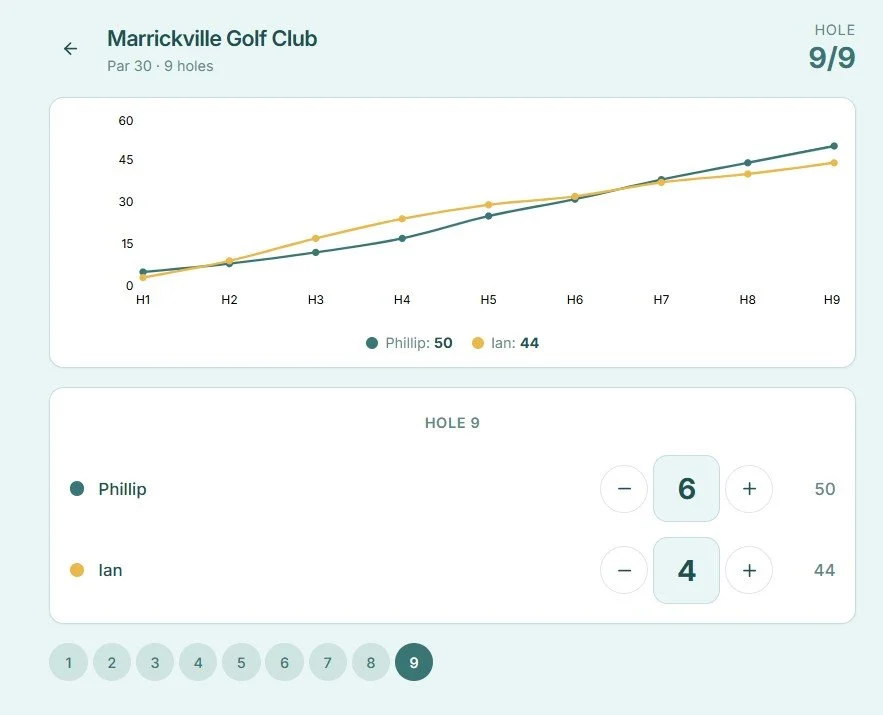
If you prefer, Pure Flow Golf also includes a minimal in-app score tracker.
This tracker is intentionally designed to be:
Fast - add up to 4 friends
Simple - enter your hole score in seconds
Low distraction - just record the score and move on
Shareable - end of round dashboard can be shared
FAQ - How Pure Golf Flow Works
-
No. Pure Golf Flow is built specifically for golfers without a handicap. It tracks your scores against par and uses your own playing history to measure improvement and predict future rounds—no official handicap required.
-
Yes. Pure Golf Flow is designed for beginners and casual golfers who want simple score tracking and clear improvement insights without complex rules, statistics, or constant phone use during play.
-
Absolutely. You can track 6, 9, 12, or 18 holes. Pure Golf Flow normalizes scores per hole, so shorter or partial rounds still count toward your overall progress and improvement tracking.
-
Pure Golf Flow measures shots over par per hole and tracks trends across recent and longer time periods. This creates a fair, consistent improvement model that works across different courses and playing formats.
-
The app uses your recent performance data to calculate an expected score based on the number of holes you plan to play and the course par. This helps you set realistic goals and measure how you’re improving over time.